
 repeated

Cat 🐈🥗 (D.Burch) 
catsalad@infosec.exchange

Kitty with antenna deployed to get better signal with the mothership.

 14
5
14
5
 1
repeated
1
repeated

unnick@booping.synth.download
unnick@booping.synth.download
0
2
0
 repeated
Noisytoot
noisytoot
0
0
0
repeated

Wendy Nather
wendynather@infosec.exchangeYou gotta wonder whether these scam farms collect and share the best reactions to these opening lines
 8
4
1
repeated
8
4
1
repeated

Noisytoot
noisytootShow content
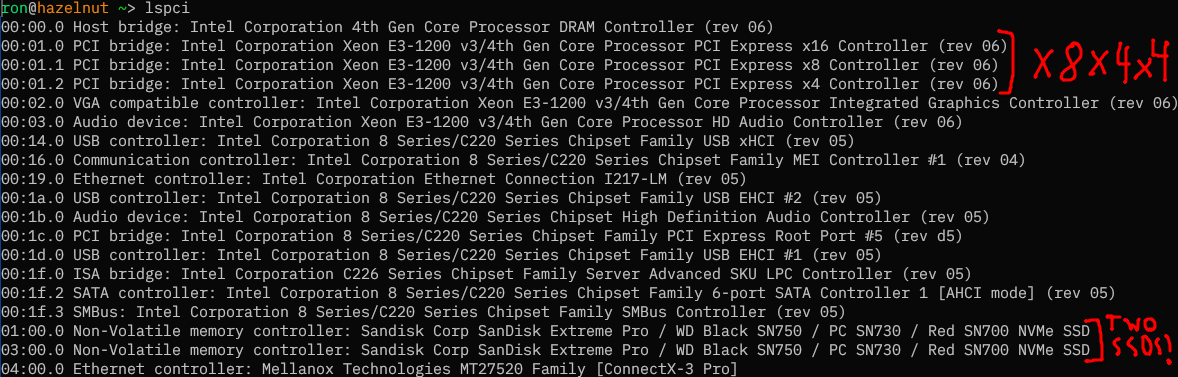
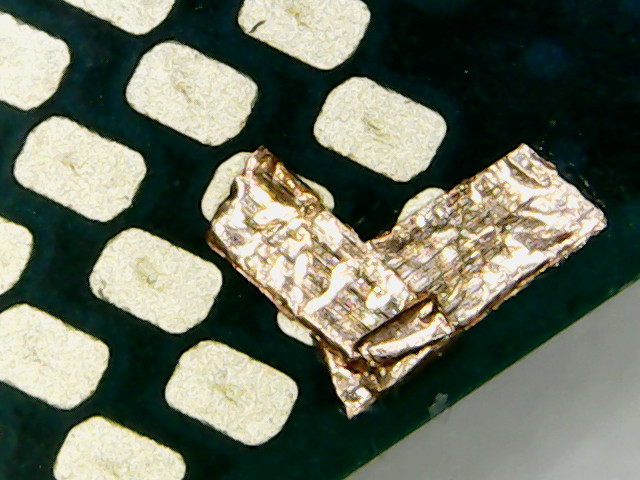
This is PCIe bifurcation (specifically, x8x4x4) being enabled on a Dell Precision T1700 SFF by connecting three pins on the bottom of the CPU using copper tape.
I wanted to have two NVMe SSDs and a 10G NIC in my new server, but the board (a Dell OptiPlex 9020 SFF) I was going to use for it only had two PCIe slots: PCIe 3.0 x16 from the motherboard, and PCIe 2.0 x4 from the PCH (Platform Controller Hub, Intel’s single-chip chipset family that they’ve used since 2009 replacing the separate northbridge and southbridge). This meant that I would either have to buy a PCIe switch (which are absurdly expensive, the cheapest 2-port PCIe 3.0 one I could find was £50 and most were a lot more), or find a way to enable PCIe bifurcation, which is supported by the CPU.
I found two articles by people who had done this before, on Haswell and Ivy Bridge, so I knew it was possible. For the PCIe lanes on the PCH this could be done in software (coreboot), but for the lanes on the CPU this needs to be done in hardware by physically setting the value of two pins on the CPU, CFG5 (U39), and CFG6 (U40) (unless the motherboard manufacturer connected those pins to the SuperIO or something, which Dell did not).
According to the CPU datasheet, both pins default to 0 if not terminated on the board, and:
| CFG5 | CFG6 | bifurcation |
|---|---|---|
| 0 | 0 | x8, x4, x4 |
| 0 | 1 | reserved |
| 1 | 0 | x8, x8 |
| 1 | 1 | x16 |
I found a schematic for my motherboard and they were connected only to pins on the XDP connector, which wasn’t soldered on (so there were just tiny pads). In order to set both pins to 0, I would need to somehow connect them to ground. I could either do it on the tiny XDP connector pads, or directly on the CPU. I found a map of the CPU pinout in the datasheet (which is quite confusingly vertically mirrored, and I couldn’t find a better one online), and decided it was easier to do it on the CPU, since there was a VSS/ground pin (V40) right next to CFG6, and it was near the edge of the CPU.
I got some copper tape and a cheap PCIe x16 to 4x M.2 adapter without a PCIe switch, and connected the three pins together (which was quite tricky to do, they’re tiny), and… it didn’t work. Only one PCIe controller showed up. I then recompiled coreboot with the other two controllers enabled in the devicetree, and it still didn’t show up.
It turns out that because Intel is evil, they had made the PCH artificially restrict which PCIe bifurcation modes the CPU was allowed to use. The OptiPlex 9020 SFF has a Q87 Express chipset, which is only allowed to use 1x16. I would need a Z87 or C220-series chipset to use the other modes. There’s no good reason for this restriction to exist, it’s purely artificial market segmentation, but I also don’t know of a way of bypassing it.
Fortunately, Dell also made the Precision T1700 SFF, which has an almost identical motherboard (to the point that the coreboot port works unmodified on both), except for one difference: it has a C226 chipset. The total cost of buying a Precision T1700 motherboard and the cheap PCIe-switch-less adapter was less than the cost of buying an adapter with a PCIe switch. Unfortunately, I only remembered about the Precision T1700 after I had already ordered an expensive adapter with a PCIe switch. Hopefully I’ll be able to return that when it arrives.
I swapped the motherboard, and… it worked! Except for one problem: the middle controller was not showing up for some reason. Only the first and fourth slots in my adapter worked. I suspect the connection between CFG5 and CFG6 wasn’t good enough, so only CFG6 ended up being set to 0. The datasheet doesn’t specify what happens in this case (“reserved”) but it seems to be that the first x8 and last x4 controllers are enabled, but not the middle x4 controller. When I redid it with another CPU (I was testing with a cheap CPU before doing it on my i7-4790k in case I ended up accidentally frying something) the problem went away and all 3 controllers showed up.
0
0
2
Noisytoot
noisytoot@ariadne is it even vulnerable to spectre if you enable mitigations, apply microcode updates, and disable SMT? my skylake desktop has
Vulnerabilities:
  Gather data sampling:      Vulnerable: No microcode
  Ghostwrite:                Not affected
  Indirect target selection: Not affected
  Itlb multihit:             KVM: Mitigation: Split huge pages
  L1tf:                      Mitigation; PTE Inversion; VMX conditional cache flushes, SMT disabled
  Mds:                       Mitigation; Clear CPU buffers; SMT disabled
  Meltdown:                  Mitigation; PTI
  Mmio stale data:           Mitigation; Clear CPU buffers; SMT disabled
  Old microcode:             Not affected
  Reg file data sampling:    Not affected
  Retbleed:                  Mitigation; IBRS
  Spec rstack overflow:      Not affected
  Spec store bypass:         Mitigation; Speculative Store Bypass disabled via prctl
  Spectre v1:                Mitigation; usercopy/swapgs barriers and __user pointer sanitization
  Spectre v2:                Mitigation; IBRS; IBPB conditional; STIBP disabled; RSB filling; PBRSB-eIBRS Not affected; BHI Not affected
  Srbds:                     Mitigation; Microcode
  Tsa:                       Not affected
  Tsx async abort:           Mitigation; TSX disabled
  Vmscape:                   Mitigation; IBPB before exit to userspace
and the one thing is is vulnerable to (Gather data sampling) isn’t spectre. it’s Skylake-S rather than Skylake-DT but I expect it would be the same
2
1
1
repeated
hexaheximal
hexaheximal@mstdn.socialRE: https://furry.engineer/@charcole/115845899626698240
The solution to cheating is to build better games.
It is a fundamental principle of cybersecurity that you cannot blindly trust the client - but many game developers don't understand that. This is why client-side anti-cheat *cannot* work.
If a client can lie to the server to gain an unfair advantage, a client can lie to the server about passing an anti-cheat check too.
The proper solution to cheating is good multiplayer network protocol design and server-side validation.
1
1
1
 repeated

/dev/urandom
rnd@toot.catfediverse PSA
the "ph-" and "ph+" content warnings are for negative and positive information about one's physical health
these are not to be confused with the "pH-" and "pH+" tags, used to inform people as to whether one has become more acidic or basic respectively
27
8
1
Noisytoot
noisytoot@lea I once heard that some bus drivers in Brazil in 1969 were arrested for training beetles to steal money from locked coin boxes, but I couldn’t find any evidence that this was true beyond the radio programme I heard it from (broadcast in 2018) and a single forum post from 2011 in which someone says they read this somewhere once and didn’t investigate further.
I’d quite like to find the original source, maybe I should try emailing the BBC about it (since presumably they’d have done some more research than reading the one forum post I found).
0
0
0
Noisytoot
noisytoot
0
0
0



Noisytoot
noisytoot
0
1
1